All Posts By

Vanessa Ramos Ferrin

TFPS Shortlisted for the ITR Europe Tax Awards 2026

By Announcements

TransFair Pricing Solutions (“TFPS”), a specialised transfer pricing and valuation advisory firm based in Luxembourg, has been shortlisted for the ITR Europe Tax Awards 2026 in the category “Luxembourg Transfer Pricing Firm of the Year.” The nomination comes from International Tax Review (ITR), one of the most respected rankings in international tax and transfer pricing.

This is the third time TFPS has been recognised in this category, following previous nominations in 2019 and 2025 — a track record that reflects the firm’s consistent, long-standing expertise in transfer pricing advisory services in Luxembourg and across Europe.

The ITR Europe Tax Awards are held annually and recognise the leading tax and transfer pricing firms and professionals across Europe. Nominees are judged on key criteria such as innovation, complexity, and the scale of the transactions and mandates they handle — making the awards a benchmark for excellence in the transfer pricing and international tax advisory industry.

The winners will be announced at the awards gala on 17 September 2026, held at The Londoner in Leicester Square, London.

TransFair Pricing Solutions provides transfer pricing, valuation, and tax advisory services to multinational groups, investment funds, and financial-sector businesses navigating complex cross-border matters. The firm’s repeated recognition by International Tax Review underlines its position as a trusted transfer pricing advisor in Luxembourg.

Full details on the ITR Europe Tax Awards 2026, including all shortlisted firms, are available at this link.

Supporting the Growth of Luxembourg’s Transfer Pricing Community

By Announcements

At TransFair Pricing Solutions, supporting the development of Luxembourg’s transfer pricing community is an important part of our professional commitment.

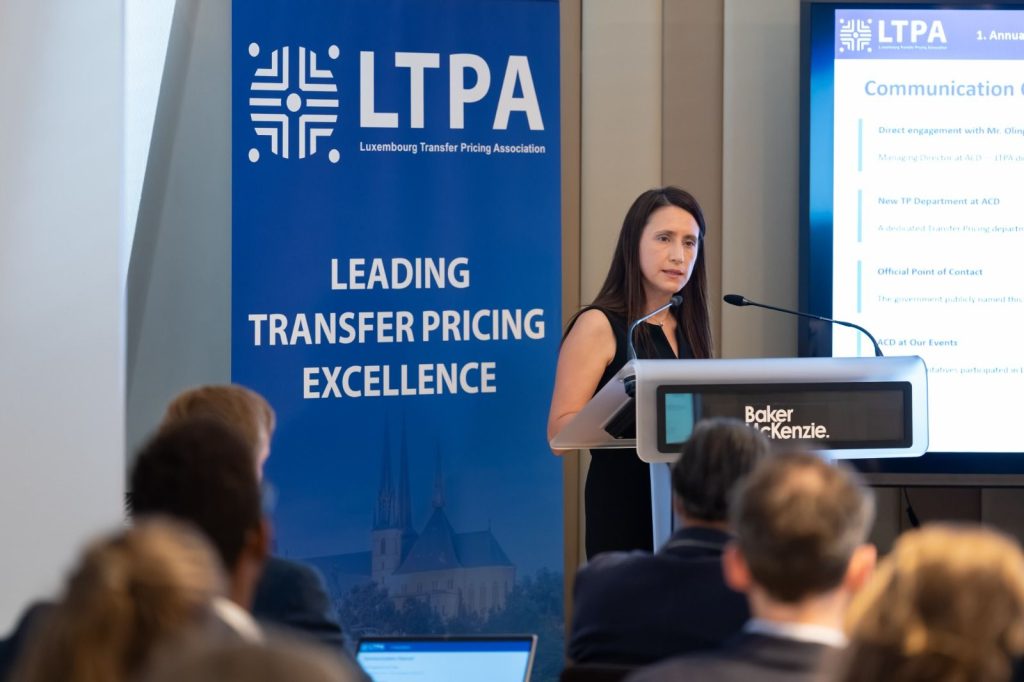
Our Managing Partner, Vanesa Ramos Ferrín, recently presented the Annual General Meeting of the Luxembourg Transfer Pricing Association (LTPA) in her capacity as President of the association.

The meeting provided a valuable opportunity to bring members together, reflect on the LTPA’s progress and continue building a shared vision for the recognition and development of transfer pricing in Luxembourg.

Building a stronger professional community

Since its establishment two years ago, the LTPA has developed a meaningful presence within Luxembourg’s tax and business landscape.

Through events, professional exchanges and collaboration between members, the association has helped create a platform where transfer pricing specialists, businesses and other stakeholders can share knowledge, discuss current developments and strengthen professional connections.

Under Vanesa’s leadership, the LTPA continues to grow as a community dedicated to advancing transfer pricing awareness and expertise in Luxembourg.

Amount B Requires Proactive
Transfer Pricing Management

By Flash news

The introduction of Amount B represents an important development in the international transfer pricing framework, particularly for multinational groups carrying out routine marketing and distribution activities.

In a recent interview with Paperjam, Vanesa Ramos Ferrín, Managing Partner of TransFair Pricing Solutions, discusses what Amount B means for businesses operating in Luxembourg and why its implementation requires proactive management rather than a purely mechanical application of the new framework.

A simplified approach to baseline distribution activities

Amount B forms part of the OECD’s Two-Pillar Solution and introduces a simplified and streamlined approach to applying the arm’s-length principle to certain in-country baseline marketing and distribution activities.

The objective is to improve tax certainty, reduce administrative complexity and limit transfer pricing disputes concerning qualifying routine distributors. The framework provides a standardised method for determining the return earned by an eligible distributor, based on the characteristics of the business and the relevant industry grouping.

However, simplification does not mean that every distribution arrangement automatically qualifies.

The Amount B guidance includes detailed scoping requirements. Eligible distributors must generally perform baseline functions and must not own unique and valuable intangibles or assume certain economically significant risks. Some activities and transactions, including the distribution of particular categories of products, may also fall outside its scope.

Luxembourg’s approach to Amount B

In April 2026, the Luxembourg tax administration issued a circular setting out how the Amount B framework applies in Luxembourg in relation to covered jurisdictions.

The circular applies to financial years beginning on or after 1 January 2025 and establishes the conditions under which Luxembourg will recognise the simplified and streamlined approach for qualifying marketing and distribution arrangements.

As Vanesa explains in the interview, Luxembourg’s recognition approach represents a meaningful step forward. Nevertheless, taxpayers must still demonstrate that their arrangements genuinely fall within the intended scope of Amount B.

Segmentation remains essential

The analysis becomes more complex where a Luxembourg entity combines routine distribution with other activities.

A company may, for example, perform distribution functions alongside manufacturing, procurement, financing, research and development, strategic marketing or other services. In such circumstances, the financial results associated with the baseline distribution activity may need to be identified and separated from those arising from the entity’s other functions.

Reliable segmentation is therefore essential. Businesses must be able to demonstrate which revenue, expenses, assets and risks relate to the qualifying distribution activity and which belong to activities outside the Amount B framework.

The Paperjam interview highlights that, for groups combining distribution with other functions, the central issues remain segmentation and economic substance.

Substance cannot be replaced by restructuring

Groups should also avoid restructuring arrangements solely to obtain access to the simplified approach.

An entity’s classification must reflect its genuine functional profile, including the functions it performs, the assets it uses and the risks it assumes. Contractual changes that are not supported by operational reality are unlikely to provide a sustainable basis for applying Amount B.

Artificially reorganising activities to bring an entity within the framework may instead attract greater scrutiny from tax authorities.

A proactive management exercise

Amount B may reduce the complexity associated with pricing qualifying baseline distribution activities, but its application still requires careful preparation.

Multinational groups should assess their distribution structures, determine whether the relevant transactions meet the scoping criteria, review the availability of segmented financial information and ensure that intercompany agreements remain consistent with actual conduct.

The key message is clear: Amount B offers simplification within its defined scope, but it does not remove transfer pricing risk. Proactive analysis, appropriate documentation and alignment with economic substance remain fundamental.

A Full Day of Transfer Pricing Training
at the House of Training

By Announcements

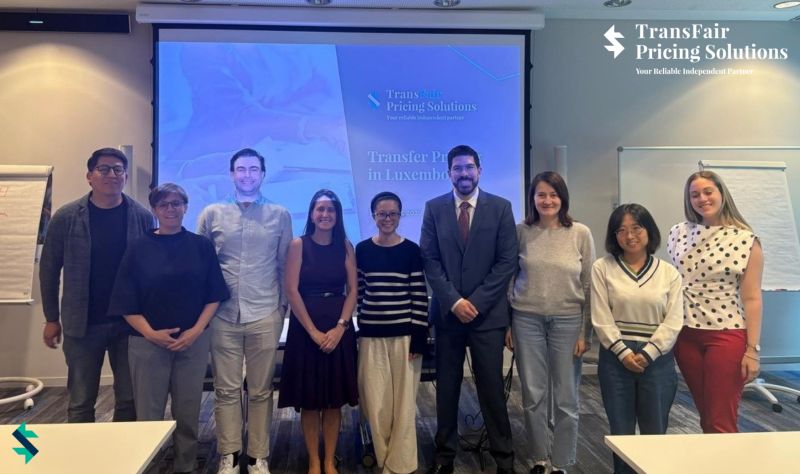
TransFair Pricing Solutions would like to thank all participants who joined our recent training session on Transfer Pricing in Luxembourg at the House of Training.

The session was led by Vanesa Ramos Ferrín, Managing Partner of TransFair Pricing Solutions, who guided attendees through a full day of technical insights, practical examples and discussions on the transfer pricing issues faced by businesses operating in Luxembourg.

An intensive and engaging programme

An eight-hour training day represents a significant commitment for participants. However, the high level of engagement, thoughtful questions and active participation throughout the session created a dynamic and rewarding learning environment.

The discussions provided an opportunity to explore transfer pricing concepts in a practical context, exchange professional perspectives and consider how transfer pricing principles are applied to real business situations.

The energy in the room and the willingness of participants to contribute made the full-day programme both productive and enjoyable.

Sharing practical transfer pricing expertise

At TransFair Pricing Solutions, we are committed to supporting the professional community by sharing specialised knowledge and practical experience in transfer pricing.

Training sessions such as this one help professionals strengthen their understanding of the Luxembourg transfer pricing environment and provide a valuable forum for discussing current challenges, practical approaches and emerging developments.

We are proud to have shared our expertise with such an attentive and motivated group and look forward to continuing these discussions through future training sessions.

Thank you to all participants for making the training a success.

Vanessa Ramos Ferrín Shortlisted for 2026 Women in Business Law EMEA Awards

By Flash news

TransFair Pricing Solutions is proud to announce that our Managing Partner, Vanessa Ramos Ferrín, has been shortlisted for the 2026 Women in Business Law EMEA Awards in recognition of her work as one of the EMEA region’s leading transfer pricing specialists.

The Women in Business Law Awards celebrate outstanding women in the legal profession who demonstrate exceptional leadership, technical expertise, strategic insight and measurable impact across their respective fields.

Vanessa’s inclusion on the 2026 shortlist places her among an exceptional group of professionals whose work continues to shape the business law landscape across Europe, the Middle East and Africa.

More than 18 years of transfer pricing expertise

Vanessa brings more than 18 years of experience in transfer pricing and valuation, advising multinational groups, investment funds and financial-sector businesses on complex cross-border matters.

As Managing Partner of TransFair Pricing Solutions, she has played a central role in developing the firm’s highly specialised transfer pricing and valuation practice. Her work combines technical expertise with a strong understanding of businesses’ commercial, financial and operational realities.

Vanessa is also President of the Luxembourg Transfer Pricing Association, where she contributes to the development of Luxembourg’s transfer pricing community and promotes dialogue between businesses, advisers, policymakers and tax professionals.

Recognition of specialist excellence

TransFair Pricing Solutions is a highly specialised transfer pricing advisory firm recognised as a Tier 1 firm by International Tax Review.

Our approach is built on technical excellence, practical insight and a commitment to providing clients with clear, commercially relevant advice. Vanessa’s nomination reflects these values and recognises her continued contribution to the transfer pricing profession in Luxembourg and internationally.

The shortlist was announced ahead of the Women in Business Law EMEA Awards ceremony, held on 25 June 2026 at The Biltmore Mayfair in London.

We congratulate Vanessa on this important recognition and are proud to see her expertise, leadership and contribution to the profession acknowledged at the EMEA level.

The Value of Transfer Pricing Documentation in Cross-Border Investments

By Announcements

In Luxembourg’s evolving transfer pricing environment, documentation is increasingly viewed as much more than a compliance requirement. It has become an essential tool for supporting the arm’s-length nature of related-party arrangements, explaining the economic rationale behind intra-group transactions and demonstrating that contractual terms reflect operational reality.

This growing importance is particularly relevant for businesses operating through cross-border investment structures. Private equity, real estate, infrastructure and private debt arrangements frequently involve several entities performing different management, advisory, financing and investment-related functions across multiple jurisdictions.

In these structures, transfer pricing documentation can help ensure that the allocation of functions, risks and remuneration is consistent with the way the business operates in practice.

From compliance file to governance tool

Historically, transfer pricing documentation was often prepared primarily as a defensive measure in case of a tax audit. However, recent Luxembourg and international developments reflect a broader approach.

Documentation increasingly serves as a governance instrument that supports pricing decisions, records the assumptions underlying a transaction and provides contemporaneous evidence of economic substance. It can also help align contractual arrangements, financial outcomes and the actual conduct of the parties.

This is especially important where tax authorities examine not only whether a price or margin falls within an arm’s-length range, but also:

  • where strategic decisions are made;
  • which entity exercises control over relevant risks;
  • whether services were genuinely performed;
  • whether the recipient received an identifiable benefit; and
  • whether written agreements are consistent with day-to-day conduct.

Why timing matters

One of the article’s central themes is the distinction between documentation prepared when a transaction is implemented and documentation prepared several years later during a tax review.

Contemporaneous documentation allows the business to record the commercial context, pricing methodology, decision-making process and supporting evidence while the relevant information remains readily available.

By contrast, documentation prepared retrospectively may require the reconstruction of historical decisions. Relevant personnel may have left the organisation, assumptions may not have been recorded and governance documents may no longer provide sufficient support for the original pricing position.

Preparing documentation early can therefore help preserve institutional knowledge, reduce reconstruction costs and provide a more credible explanation of the transaction during a future audit.

Documentation as evidence of economic substance

Recent Luxembourg case law also illustrates that contracts are only the starting point of a transfer pricing analysis.

Where the conduct of the parties differs from the written agreement, the actual conduct may prevail when the transaction is delineated. Transfer pricing documentation must therefore be consistent with governance practices, decision-making records, accounting treatment and operational evidence.

For cross-border investments, this may require maintaining supporting materials such as:

  • board minutes and governance documentation;
  • internal policies and decision-making records;
  • functional and value-chain analyses;
  • evidence of risk management and control; and
  • operational records demonstrating that services were performed.

A strategic risk-management instrument

Robust documentation can also reduce the likelihood of misunderstandings during tax audits, conflicting adjustments between jurisdictions and prolonged dispute-resolution procedures.

As international cooperation and the exchange of information between tax administrations continue to increase, consistency across jurisdictions is becoming particularly important. The same transaction may otherwise be interpreted differently by different tax authorities, creating a risk of double taxation.

The article concludes that transfer pricing documentation should not be treated as a year-end exercise prepared after transactions have already been completed. Instead, it should be integrated into the design, implementation and ongoing monitoring of cross-border arrangements.

Approached in this way, documentation becomes an instrument of strategic clarity and risk management—supporting not only how transfer prices are defended, but also how they are established.

Vanessa Ramos Ferrín’s article, “The Value of Transfer Pricing Documentation in Cross-Border Investments,” was originally published in Tax Notes International on 20 April 2026.

Transfer Pricing on the Deal Side: Key Takeaways from Our April Session

By Flash news

On 15 April, TransFair Pricing Solutions welcomed participants for an intensive and highly interactive session on “Transfer Pricing on the Deal Side”, bringing together tax and transfer pricing professionals to discuss how transfer pricing considerations increasingly influence the structuring, execution and subsequent review of transactions.

The session was led by Vanesa Ramos Ferrín, Partner at TransFair Pricing Solutions and President of the Luxembourg Transfer Pricing Association (LTPA), who guided participants through a series of practical transaction scenarios, recurring transfer pricing challenges and recent audit trends observed in Luxembourg and in cross-border contexts.

Over the course of two intensive hours, the discussion focused particularly on transactions involving investment funds, asset management structures and financing arrangements, areas in which transfer pricing questions can become especially complex due to the interaction between legal structuring, functional substance, financing conditions, governance and the allocation of risks and returns.

Through concrete examples, participants examined how transfer pricing issues may arise at different stages of a transaction — from the initial structuring and due diligence process to post-acquisition integration, refinancing and subsequent tax audits. The session also highlighted the importance of identifying potential transfer pricing implications sufficiently early in the deal process rather than addressing them only once a transaction has already been implemented.

Particular attention was given to common areas of risk, including the appropriate remuneration of entities involved in the transaction, the pricing and documentation of intra-group financing arrangements, the allocation of functions and risks between group companies, and the growing importance of demonstrating that contractual arrangements are supported by the actual conduct and economic substance of the parties involved.

The discussion also reflected on the increasingly detailed scrutiny applied by tax authorities to complex financial and investment structures. Participants exchanged experiences regarding current audit approaches and considered how robust transfer pricing documentation, consistent governance and a clear understanding of the underlying value creation can help organisations anticipate and manage potential challenges.

A special thank you goes to Maximilian Hangler-Garulo, Tax Counsel at GSK Stockmann, who joined the session as guest speaker and shared valuable insights drawn from his experience in deal-related tax and transfer pricing matters. His contribution provided an important legal and transactional perspective and helped create a thoughtful and constructive dialogue between speakers and participants.

One of the key messages emerging from the session was clear: transfer pricing should not be treated as an isolated compliance exercise at the end of a transaction. When considered early, it can play an important role in identifying risks, supporting appropriate transaction structures and ensuring that the economic rationale, contractual arrangements and actual conduct of the parties remain aligned.

We would like to thank all participants for their active engagement, practical questions and open exchange of experiences. The quality of the discussion demonstrated the value of bringing together professionals from different areas of tax, legal and transaction advisory work to explore the challenges encountered in real-life transactions.

TFPS was awarded in the World Transfer pricing 2026

By Announcements

TransFair Pricing Solutions has been ranked Tier 1 for Transfer Pricing in Luxembourg in the World Transfer Pricing 2026 guide published by International Tax Review (ITR).

This recognition places TransFair Pricing Solutions among the leading transfer pricing advisory firms in Luxembourg and underscores the firm’s commitment to technical excellence, client service, and the continued advancement of Luxembourg’s transfer pricing practice.

The ITR World Tax and World Transfer Pricing guides are regarded as the most comprehensive global directories of top-performing tax and transfer pricing firms. They assess and profile the most proficient practitioners and firms across more than 140 jurisdictions worldwide. Unlike other rankings, the World Tax and World Transfer Pricing series cover professionals from a broad range of disciplines, law firms, consultancies, and advisory groups, offering the most extensive overview of the international tax and transfer pricing market.

The full World Transfer Pricing 2026 ranking can be viewed on International Tax Review’s website here.

TFPS Shortlisted for the ITR Europe Tax Awards 2025

By NEWS

TransFair Pricing Solutions (“TFPS”), a specialised transfer pricing and valuation advisory firm based in Luxembourg, was shortlisted for the ITR Europe Tax Awards 2025 in the category “Luxembourg Transfer Pricing Firm of the Year.”

The recognition by International Tax Review (ITR), one of the leading international publications and rankings in tax and transfer pricing, marked the second time TFPS had been nominated in this category, following its previous recognition in 2019.

The ITR Europe Tax Awards are held annually to recognise leading tax and transfer pricing firms and professionals across Europe. Firms are assessed on criteria including innovation, complexity, impact and the scale of the transactions and mandates handled, making the awards an established benchmark of excellence within the international tax and transfer pricing industry.

TransFair Pricing Solutions provides transfer pricing, valuation and tax advisory services to multinational groups, investment funds and financial-sector businesses navigating complex cross-border matters.

TFPS’s recognition at the ITR Europe Tax Awards 2025 reflects the firm’s continued commitment to delivering high-quality, specialised transfer pricing advisory services in Luxembourg and internationally.

Luxembourg’s New Transfer Pricing Rules: Implications for Shareholder and Intra-Group Current Accounts

By Regulations update

On February 3, 2025, the Luxembourg tax authorities (LTA) issued Circular L.I.R. 164/1, replacing the 1998 circular on the determination of interest rates for debit current accounts held by shareholders or partners of entities subject to corporate income tax.[1] This update introduces new benchmarks for market-based interest rates and strengthens the performance of transfer pricing documentation, particularly in relation to the treatment of shareholder and intra-group current accounts.

The revised circular is particularly relevant for companies with shareholder or partner debit current accounts, entities engaged in intra-group financing or treasury activities, and businesses subject to Luxembourg corporate income tax.[2] In cases where the LTA identifies inconsistencies or inadequate documentation, companies may face administrative penalties, financial adjustments, or even legal consequences.

This article provides an analysis of the transfer pricing compliance process, new regulatory considerations for Shareholder and Intra-Group Accounts, the Transfer Pricing assessment and dispute process in Luxembourg and overview of recent transfer pricing court cases in Luxembourg.

  1. The Transfer Pricing Compliance Process in Luxembourg

Luxembourg’s transfer pricing framework is outlined in Article 56 and 56bis of the Luxembourg Income Tax Law (LITL), §171 of the Luxembourg Tax Code, and Circular L.I.R. No. 56/1-56-bis/1 (the “Transfer Pricing Circular”). These rules establish that all transactions between a Luxembourg company and associated enterprises must adhere to arm’s length market conditions, including those involving business restructurings.[3] To that end, a transfer pricing analysis must be prepared following the Transfer Pricing Circular and the latest OECD Transfer Pricing Guidelines.[4]

Unlike other jurisdictions where transfer pricing documentation must be submitted alongside tax returns, in Luxembourg, businesses are not required to submit documentation proactively but must maintain it and provide it upon request.[5] Furthermore, taxpayers must indicate within their annual corporate income tax return whether they engage in intra-group transactions, regardless of their nature or amount. This disclosure obligation requires the attachment of an appendix demonstrating the application of the arm’s length principle in intercompany transactions, ensuring compliance with §171 of the Luxembourg Tax Code.

Many businesses assume that once their transfer pricing documentation is prepared and tax returns are filed, they have fulfilled their obligations. However, transfer pricing compliance is a continuous process. The LTA can reassess tax returns until the tax assessment is issued and until the statute of limitations expires, which is generally five years but may extend to ten years in cases of non-declaration or inaccurate reporting, regardless of fraudulent intent.[6]

  1. New regulatory considerations for Shareholder and Intra-Group Current Accounts

The new Circular L.I.R. 164/1 provides specific guidance on how interest rates should be determined for debit current accounts, distinguishing between cases where the shareholder or partner is a natural person or a related enterprise.[7]

  1. The shareholder or partner is a natural person

For individual shareholders or partners, interest rates must align with market rates, and companies may refer to the average consumer loan rates published by the Banque Centrale du Luxembourg.

Interest must be recorded at the end of the financial year and calculated following standard banking industry practices.

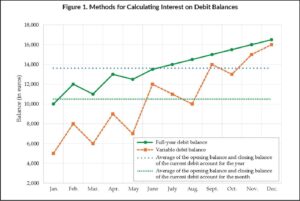
  • If the current account remains in a debit position throughout the entire financial year, the applicable interest charge should be based on the arithmetic average of the opening and closing balances.
  • If the debit current account did not exist for the entire duration of the financial year or if there were significant variations in the balances, the arithmetic average of the debit balances at the end of the different months should be considered.

The following graph illustrates the methods for calculating the interest on debt balances:
  1. The shareholder or partner is a related enterprise

For related enterprises, interest rates must comply with transfer pricing rules under Articles 56 and 56bis L.I.R., considering factors such as currency denomination, exchange rate risks, refinancing costs, and loan maturity.

Additionally, the provisions of Circular L.I.R./N.S. No. 164/1 (1993) remain applicable, particularly regarding the criteria for a repayable debit current account.[8]

To emphasize that debit current accounts must be structured as repayable loans, businesses must ensure that:

  • A formal repayment obligation exists rather than an informal arrangement.
  • Failure to repay may lead to reclassification as a hidden profit distribution.
  • Even if the loan is deemed legitimate, non-payment of interest could still be taxed as a hidden distribution.
  1. Implications and risks for Businesses

Assess the legal and economic substance of shareholder and intra-group debit accounts

  • Ensure that shareholder loans recorded as debit current accounts meet the criteria of a repayable loan, as outlined in Circular L.I.R./N.S. No. 164/1 of June 9, 1993.
  • Verify that the debit current account represents an actual loan with a structured repayment schedule rather than an indirect dividend or hidden profit distribution.

Verify the presence of a formal loan agreement

  • A repayable debit account should be supported by a written loan agreement, including:
  • A fixed repayment schedule
  • Agreed interest rate based on market conditions
  • The company’s expectation of full repayment
  • If no agreement exists, or repayment is not realistically expected, the account risks being recharacterized as a hidden profit distribution.

Ensure that interest is accrued and paid in line with market rates

  • Interest must be determined in accordance with the specifications in section 1 and 2 of this section.
  • Interest must be accrued properly to avoid the risk of tax adjustments.
  • If interest is not regularly paid, tax authorities may consider the unpaid interest as a hidden distribution of profits.

Monitor repayment activity to avoid reclassification risks

  • Regularly review debit current accounts to ensure that the repayment schedule is being followed.
  • If repayment has been delayed or abandoned, the transaction may be retroactively reclassified as a distribution under Article 164, paragraph 3 of the Luxembourg Income Tax Law (L.I.R.).

Implement strong internal documentation to justify loan treatment

  • Maintain detailed records of:
  • The original loan agreement
  • Interest payments and adjustments
  • Any changes to the repayment schedule
  • In case of a tax audit, these documents will help substantiate that the debit current account is a legitimate, repayable loan rather than a hidden profit distribution.

III. Conclusions

The introduction of Circular L.I.R. 164/1 (2025) represents a significant shift in Luxembourg’s transfer pricing landscape, particularly regarding shareholder and intra-group current accounts. The updated guidance reinforces the importance of market-based interest rate determination and proper transfer pricing documentation, emphasizing compliance with Articles 56 and 56bis L.I.R. and OECD guidelines.

Companies must ensure that intra-group financing arrangements adhere to the arm’s length principle and that shareholder debit current accounts are structured as repayable loans to avoid reclassification as hidden profit distributions. Failure to comply may result in tax reassessments, administrative penalties, and reputational risks.

A longer version of this article was originally published in the March 10, 2025, issue of Tax Notes International.

About the Author:

* Vanessa Ramos is the Managing Partner of TransFair Pricing Solutions (TFPS) and President of the Luxembourg Transfer Pricing Association. She is a transfer pricing and valuation expert with over 16 years of experience and she specializes in transfer pricing audit defense, advance pricing agreements, documentation, benchmarking, transfer pricing planning, and other economic compliance services.

The author may be contacted at: v.ramos@tfps.lu

Footnotes

[1] Circular L.I.R. 164/1, issued February 3, 2025, by the Luxembourg Tax Authorities.

[2] Article 164(3) of the Luxembourg Income Tax Law (L.I.R.).

[3] §171 of the Luxembourg Tax Code.

[4] OECD Transfer Pricing Guidelines (2022).

[5] §171 of the Luxembourg Tax Code.

[6] §144 of the Luxembourg General Law on Taxation.

[7] Circular L.I.R. 164/1, issued February 3, 2025, by the Luxembourg Tax Authorities.
[8] Circular L.I.R./N.S. No. 164/1, issued June 9, 1993, by the Luxembourg Tax Authorities.